Diamond Identity Verification for GIA-Certified Stones
The last line of defense for Vietnamese consumers.
Summary
A GIA report certifies a diamond's characteristics at grading time; it cannot guarantee the stone being traded is that same stone. Independent identity verification matches the natural inclusion “fingerprint” against GIA's plot, then seals the stone under the Chain of Custody principle to preserve the link between the diamond and its record.
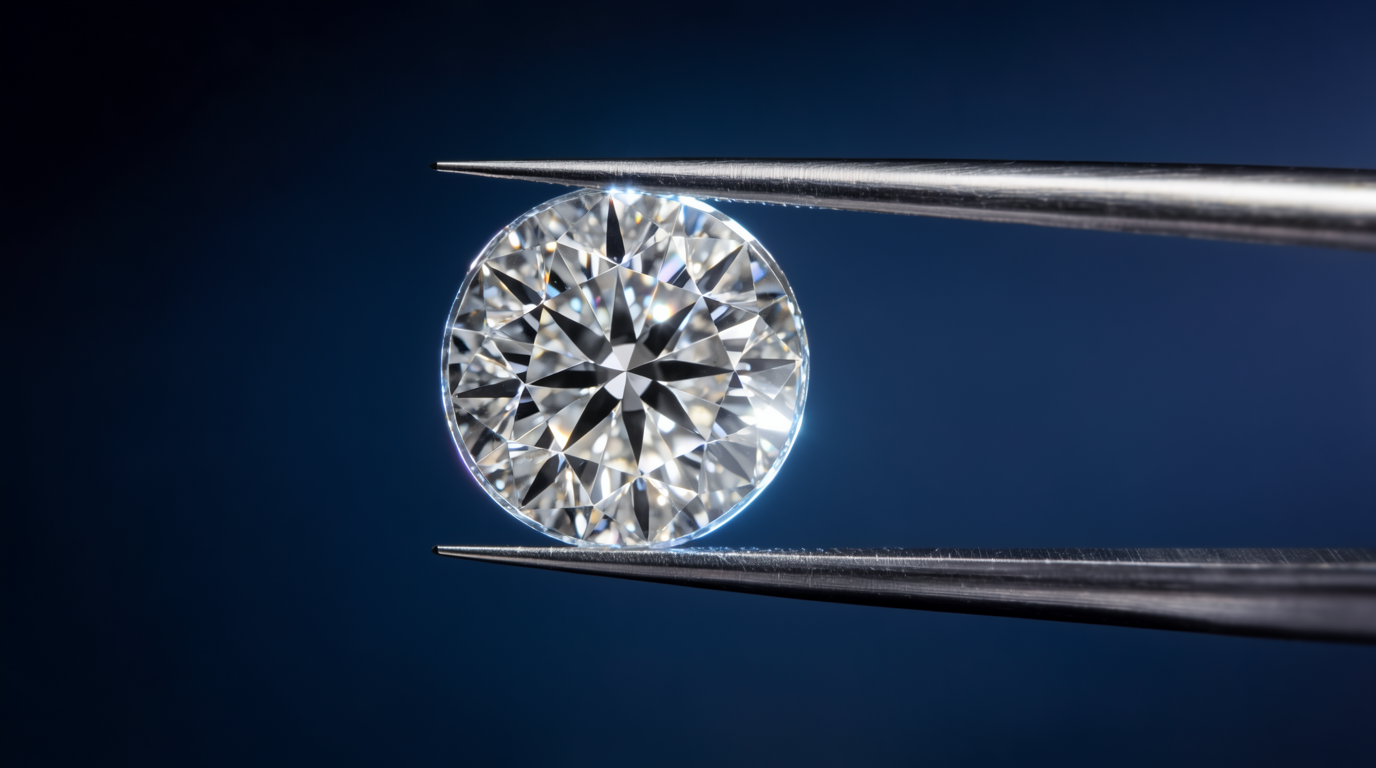
For more than half a century, GIA (Gemological Institute of America) has become one of the world's most authoritative diamond laboratories. A GIA report is regarded as the global diamond market's “common language,” giving buyers and sellers a shared basis for judging a diamond's quality.
However, the scientific nature of a GIA report must be understood correctly:
The gap between “the certificate” and “the diamond being traded” is exactly where fraud can arise if there is no independent identity-verification step.
That is why, as the diamond market grows and lab-grown diamond technology becomes ever more sophisticated, verifying the identity of a GIA-certified diamond becomes the last line of defense protecting the consumer.
What does a GIA report confirm?
A GIA report fully describes a diamond's information at the time of grading, including:
- Carat weight;
- Color grade;
- Clarity grade;
- Cut grade;
- Symmetry;
- Polish;
- Fluorescence;
- Proportions;
- The clarity plot;
- The report number;
- The laser inscription (if any).
This information is like an “identity file” for the diamond. But just as a vehicle registration cannot prove the car in front of you is the registered one without checking the chassis number, engine number, and other identifying features, a GIA report must be reconciled against the actual stone being traded.
Real-world risks
Today, CVD and HPHT synthetic-diamond technology has reached a very high level. Many lab-grown stones have:
- nearly equivalent dimensions;
- very close weight;
- very attractive color;
- very high clarity.
If a stone is finished to the right dimensions and carries a laser number matching the one recorded on the certificate, someone without expertise or proper equipment will find it very hard to establish the stone's true identity.
This does not mean every stone can be faked, but it shows that relying on the certificate or the laser number alone is not enough to guarantee absolute safety in a transaction.
Identity is established by a natural “fingerprint”
This is the single most important principle in modern grading. Forming over billions of years underground, every natural diamond develops a unique system of inclusions, crystal growth marks, and internal features. No two natural diamonds are exactly alike in these features.
Experts commonly call this the Diamond Fingerprint (the diamond's fingerprint). That is the highest-value scientific basis for identification.
The role of the gemologist
Identity verification is not merely reading specifications. The gemologist must:
- observe dozens of microscopic features;
- compare them against GIA's inclusion plot;
- evaluate crystal-growth characteristics;
- recognize signs of treatment;
- recognize signs of a synthetic diamond;
- evaluate all the data as a whole.
This is work that demands many years of experience.
The role of modern instruments
No single instrument can answer every question. A professional laboratory typically combines:
- a gemological microscope;
- a darkfield microscope;
- fluorescence observation equipment;
- CVD and HPHT detectors;
- a spectrometer;
- laser-inscription verification tools;
- optical analysis instruments.
The combination of human expertise and instruments yields the highest reliability.
Why are many shops not equipped to verify?
Most shops focus on trading. Identity verification, by contrast, requires:
- very large investment in equipment;
- a rigorous professional process;
- trained gemologists;
- experience handling thousands of diamonds.
That is why independent verification is usually performed at specialized laboratories.
The independent verification certificate
After completing verification, the laboratory issues a Diamond Identity Verification Certificate. Its contents not only state that the stone is consistent with the GIA report, but also record:
- the inspection date;
- the condition of the stone;
- the verification result;
- an identification code;
- the gemologist responsible.
This is a basis for greater transparency and trust between the parties in a transaction.
Sealing — the final link in the chain of protection
A diamond that has been verified but not sealed can still be substituted before it reaches the buyer. After grading, therefore, the diamond should be placed in a dedicated tamper-evident package. Sealing does not certify the diamond's quality; it guarantees the continuity of identity between the moment of grading and the moment of trade.
In gemological science this is the Chain of Custody principle — an unbroken chain preserving a specimen's integrity. It is widely used in forensics, testing, and many technical fields with high authenticity requirements. Applied to diamond grading, it sharply reduces the risk of substitution or swapping after the stone has been verified.
What it means for Vietnamese consumers
A safe transaction process should include three layers of protection:
- 1Layer oneThe diamond carries a grading report from GIA or another reputable international laboratory.
- 2Layer twoAn independent laboratory verifies that the physical stone is consistent with the GIA report.
- 3Layer threeAfter verification, the diamond is issued a confirmation and sealed to preserve its integrity until the transaction is complete.
These three layers complement one another, forming a comprehensive control mechanism that helps curb fraud and improve market transparency.
Conclusion
In an era where synthetic-diamond technology advances rapidly and methods of fraud grow ever more sophisticated, a GIA report retains its full value as the international standard for assessing quality. However, to ensure that the diamond being traded is the one GIA graded, an additional identity-verification step — using expertise, instruments, and an independent process — is needed.
Identity verification does not change the value of a GIA report; it is the necessary additional step that preserves the link between the physical diamond and its grading record. Combined with a confirmation certificate and sealing after grading, this process becomes an important line of defense — protecting consumers' interests, improving transaction transparency, and strengthening confidence in Vietnam's diamond market.
Frequently Asked Questions
- What is diamond identity verification?
- It is an independent step that confirms the diamond being examined is the one matching its GIA report, rather than grading quality again. It focuses on whether the stone has the correct identity.
- Why is the inclusion “fingerprint” more reliable than a laser inscription?
- Every natural diamond forms over billions of years, giving it a unique system of inclusions and internal features that cannot be copied. A laser inscription, by contrast, can be polished off, re-engraved, or faked.
- What equipment is needed to verify a diamond's identity?
- A professional laboratory combines several instruments: gemological and darkfield microscopes, fluorescence observation, CVD/HPHT detectors, spectrometers, and laser-inscription verification tools. No single instrument answers every question.
- What does Chain of Custody mean in diamond grading?
- It is the principle of sealing the stone immediately after verification to preserve identity continuity from the moment of grading to the transaction. Sealing does not certify quality; it prevents substitution after the stone has been checked.
Have a Diamond to Verify?
Look up a grading report with your Stone ID.