Why a GIA-Certified Diamond Still Needs Independent Verification Before Trading in Vietnam
A scientific and practical perspective on protecting the buyer.
Summary
A GIA report certifies a diamond at grading time, but it cannot guarantee the stone being traded today is that same stone. Because diamonds and certificates get separated — and lab-grown stones look increasingly identical — an independent check matches the inclusion “fingerprint” to confirm the stone is the one GIA graded.
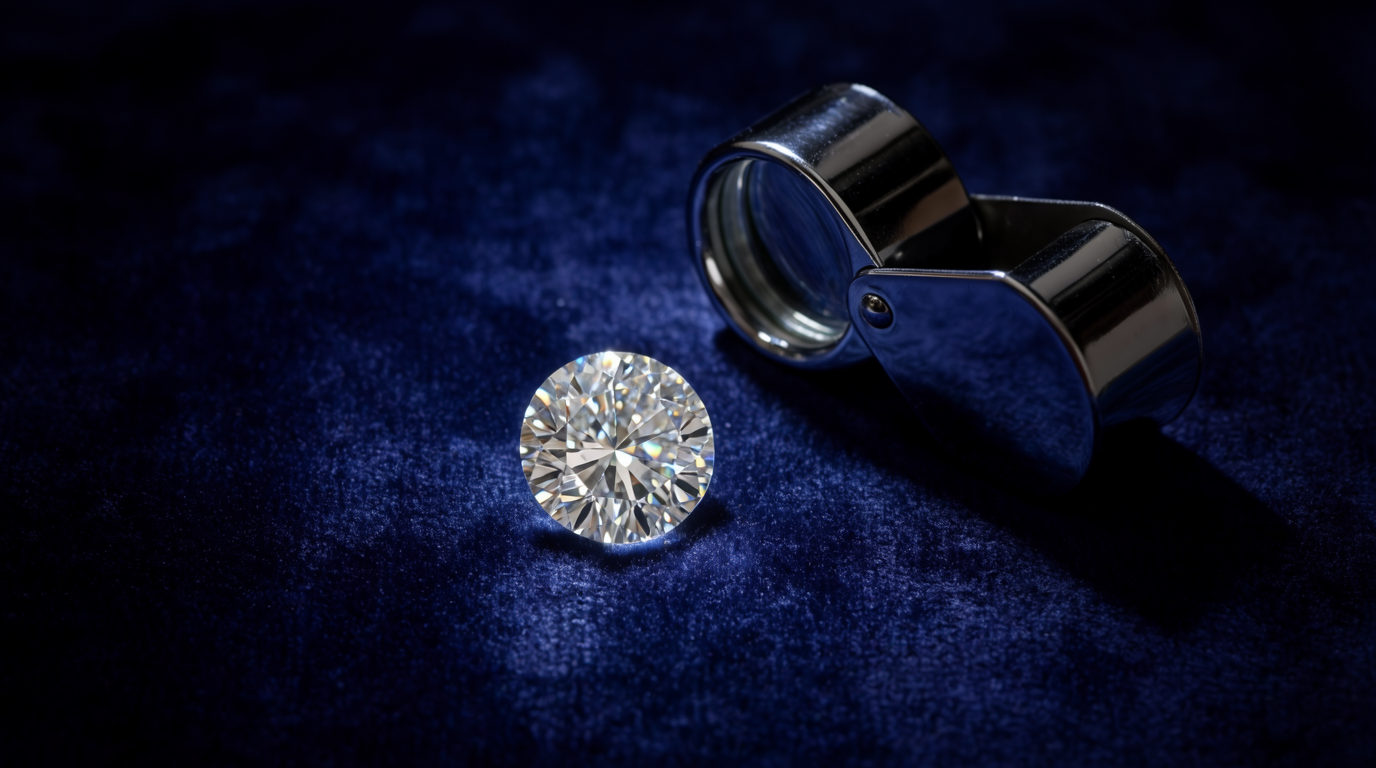
In the diamond trade, a report from the GIA (Gemological Institute of America) is regarded as one of the world's most authoritative grading standards. A GIA report fully records a diamond's identifying characteristics at the moment of grading, including carat weight, color, clarity, cut, proportions, fluorescence, an inclusion plot, and other technical data.
However, one thing must be understood correctly:
That is why, in many countries and especially for high-value transactions, buyers ask for an independent verification step before closing the deal.
Why verify again?
In practice, a diamond and its certificate can become separated as they move through the market.
If a buyer compares only by eye, or only checks the laser inscription on the edge of the stone (the girdle), a risk of fraud remains.
Forms of fraud documented in international markets include:
- swapping a natural diamond for another of nearly identical size;
- substituting a lab-grown diamond (CVD or HPHT) of similar size and weight;
- altering or falsifying identifying information;
- exploiting similar physical specifications to mislead the buyer.
In particular, as synthetic-diamond technology advances, many lab-grown stones now reach very high quality in color, clarity, and cut. Weight, size, or a laser inscription on the girdle cannot be treated as the sole basis for confirming that a diamond matches its certificate.
A laser inscription is not absolute proof
Many diamonds today carry a laser-engraved report number on the girdle. It is a useful identifier, but not a conclusion on its own.
Technically, laser inscription can be applied to various diamond materials once they are suitably finished. A gemologist therefore never relies on the inscription alone to establish a stone's identity. Any conclusion must rest on a combination of several technical factors.
The role of an independent laboratory
A professional laboratory does more than read the certificate — it examines the diamond comprehensively using:
- high-magnification specialized microscopy;
- equipment to observe and compare inclusions (clarity characteristics);
- laser-inscription verification systems;
- CVD and HPHT synthetic-diamond detectors;
- instruments that identify signs of treatment;
- optical and spectroscopic instruments for distinguishing natural from synthetic diamonds;
- a process that reconciles every specification against GIA's record.
Most important of all is comparing the diamond's natural “fingerprint.” Every naturally formed diamond carries a unique system of inclusions, crystal growth marks, internal features, and microscopic signatures. This is regarded as the diamond's “fingerprint.”
Experienced experts compare these features against the inclusion plot and data on the GIA report. If they do not match, there is reason to suspect that the present stone is not the one GIA certified.
Why are many shops not equipped to detect this?
Many gold, silver, and gemstone businesses are primarily engaged in buying and selling. They may own basic testing equipment for day-to-day trade.
Verifying accurately whether a diamond truly is the one recorded on a GIA report, however, requires:
- deeply trained gemologists;
- real-world experience handling large numbers of specimens;
- high-precision specialized instruments;
- an independent grading process;
- the ability to synthesize and evaluate many technical data sets at once.
As a result, not every shop has the full professional capability to reach a final conclusion in cases that call for verifying a diamond's identity.
What an independent verification certificate means
After completing the examination, the laboratory issues an Independent Verification Certificate, stating clearly whether the examined diamond is consistent with the characteristics of its GIA report, and recording the identifying information and the professional findings.
This is an important document that helps to:
- increase transparency in the transaction;
- create a legal and professional basis for the sale;
- strengthen trust between the parties;
- support resolution should a dispute arise.
The value of sealing after verification
After verification, the loose diamond should be placed in a dedicated tamper-evident package with its own identification code. The purpose of sealing is to:
- ensure the verified stone is not altered after grading;
- reduce the risk of substitution during transport or storage;
- preserve the link between the diamond, the GIA report, and the independent laboratory's certificate;
- give buyers, sellers, and financial institutions peace of mind in a transaction.
If the seal remains intact, the diamond's chain of identity is guaranteed continuously from the moment of grading to the moment of trade.
Conclusion
As synthetic-diamond technology advances and methods of fraud grow more sophisticated, holding a GIA report is very important but is not the whole of what keeps a buyer safe. A transparent transaction should include three steps:
- The diamond carries a grading report from GIA or another reputable international laboratory.
- An independent laboratory with the professional capability and modern equipment verifies that the physical diamond is consistent with the GIA report.
- After verification, the diamond is issued a confirmation and sealed to preserve its integrity throughout storage and trade.
It is the combination of an international report, independent verification, and professional sealing that creates an effective protection mechanism for consumers — helping to reduce the risk of substitution and fraud and to improve the transparency of Vietnam's diamond market.
Frequently Asked Questions
- Does a GIA report prove a diamond is genuine?
- A GIA report certifies the characteristics of the stone GIA examined when the report was issued. It does not automatically guarantee the diamond being traded today is that same stone, so a physical check is still needed before a high-value sale.
- Is the laser inscription on the girdle enough to verify a diamond?
- No. A girdle laser inscription is a useful identifier, but it can be applied to various diamond materials. A gemologist never relies on the inscription alone to establish a stone's identity.
- How do you tell a natural diamond from a lab-grown one?
- It requires dedicated CVD/HPHT detection equipment together with high-magnification microscopy and spectroscopic analysis. Matching weight, size, or cut is not enough to conclude.
- What does independent verification involve?
- Reading the GIA report, examining the stone with specialized instruments, matching the inclusion plot (the fingerprint), then issuing a confirmation and sealing the stone to preserve the link between the diamond and its paperwork.
Have a Diamond to Verify?
Look up a grading report with your Stone ID.